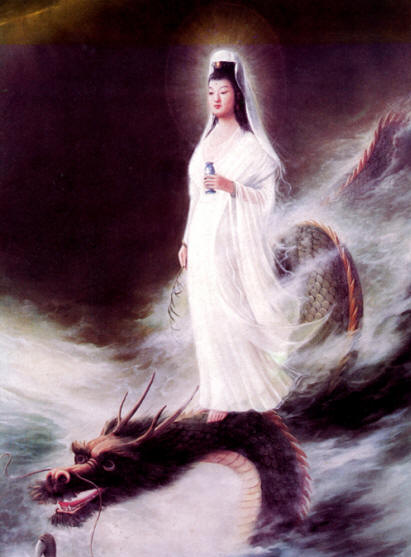
Kuan Yin is the Buddhist goddess of compassion and mercy.
I’ve seen dragons my whole life. The mythical beasts are everywhere in Asian culture — in paintings, carved into furniture, featured on calendars, and living on through Asian folktales and operas.
My mom once gave me a painting of a beautiful woman standing on a dragon. I later learned it was Kuan Yin, the Buddhist goddess of compassion and mercy.
I asked her and her friends about the painting and was told a story about a dragon appearing in the clouds. It was the year my Taiwanese mother and my Caucasian U.S. serviceman father met in Taiwan. There was a great typhoon. Flooding. Devastation. Many people lost their homes and lives. The people called out, "Gwan Yim Posa, Gwan Yim Posa, Gwan Yim Posa!" — the Taiwanese name for Kuan Yin.
While the typhoon flooded the island, some American servicemen stationed in Taiwan took aerial photographs of the storm clouds. When they returned to the military base to develop the film, the men could see an image of Kuan Yin standing on the head of a dragon within the cloud formations.
This Asian dragon doesn’t look frightening like many dragons in European mythology. It looks powerful and focused — and Kuan Yin appears poised and calm.
Chinese dragons traditionally symbolize power, strength, and good luck. They control all the elements, including weather forces and flooding. While European kings called for their dragons to be killed, the emperor of China drew strength from the dragon as a symbol of imperial power.
European and classic Greek dragons are usually evil and something to be conquered or destroyed, whether it’s the medieval knight in shining armor slaying the dragon or Perseus of Greek mythology rescuing Andromeda, who had been chained to a rock as an offering to a dragon. More recent fantasy depictions have been less negative and present dragons as intelligent, such as in the Harry Potter books and films, Anne McCaffrey's Dragonriders series, Christopher Paolini’s Eragon books, and the "Merlin" television show.
But Asian dragons have always been admired by other cultures for their powerful attributes.
Since 2012 is the Year of the Dragon, I thought I’d refer once again to Rosemary Gong’s book, The Essential Guide to Chinese American Celebrations and Culture, for insight into the historic significance of dragons.
"Dragons are believed to be mythical creatures wielding great powers and are highly respected by the Chinese. The energies of a dragon can be tapped for a positive outcome that relates to the principles of yin and yang and good and evil," Gong writes. "These creatures symbolize fertility, strength, and vitality, with the popular dragon types being Long, Li, Jiao, and Mang."
Author Gong goes on to provide definitions of the four main dragons, which appear to be divided by type as well as socioeconomic class:
The Long dragon is a fire breather and the imperial symbol. It is the ruling-class dragon, has five claws, and is considered powerful. This dragon can be a mixture of nine common animals, which explains why Asian dragons sometimes have different heads or combinations of characteristics of non-reptilian creatures.
The hornless, water-breathing Li is the water dragon, which rules the rivers, seas, rain, and directions of the compass. "Offerings are made to this creature during the harvest season," writes Gong.
The third dragon Gong describes is Jiao, the earth dragon, which has the landscape of hills and mountains carved on its back. If one observes the concepts of feng shui — in effect complying with this dragon’s energy — good fortune and success will come.
Finally, the Mang dragon is for the common people. With only three or four claws, sadly it’s considered ordinary. It seems rather classist to me, but it’s proper that the common people are represented. Even if Mang isn’t as strong, it’s still a dragon and symbolizes something more powerful than humans.
Right now, when the world seems to be in great turmoil, we could all use the power, strength, and good luck of a dragon to help us through hard times. Here’s to Long, Li, Jiao, and Mang. May they give us strength, energy, and vitality for 2012!
|