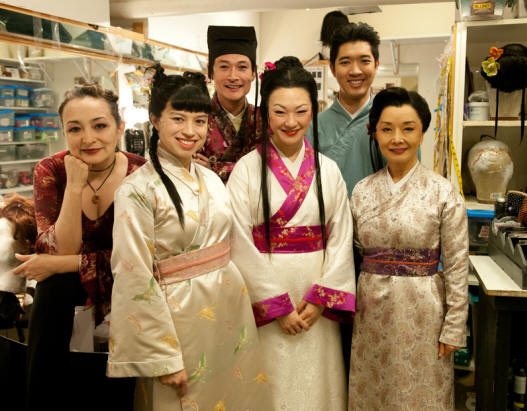
Pictured are cast members of the Oregon Shakespeare Festival’s The White Snake — (L-R) Lisa Tejero, Tanya McBride, Cristofer Jean, Amy Kim Waschke, Vin Kridakorn, and Ako. (Photo/Jenny Graham, courtesy of the Oregon Shakespeare Festival)
In the 1990s, I wrote several plays produced in Portland and around the country featuring Asian-American actors. At the time, I didn’t know it would be the golden age of Asian-American theatre in Portland. Many of the actors I worked with moved away after I focused on radio work instead of playwriting. I thought someone else would pick up the mantle. There have been occasional plays in the last decade, but not enough to entice more Asian actors to stay in Portland. In fact, white actors often fill Asian roles in plays here.
The ’90s also seem to have been the golden age of theatre for Asians in New York City. The lack of Asian representation was made clear to me when I learned of a recent poll and report conducted by the Asian American Performers Action Coalition (AAPAC), a group of New York City theatre professionals, that asked 16 off-Broadway theatre companies how many actors of color were hired in the last five years. The report — "Ethnic Representation on New York City Stages 2006/07-2010/11 Seasons" — led to a series of roundtable discussions.
According to the report, 80 percent of roles went to white actors. Significant gains seemed to have been made for African-American actors (13 percent) with a minimal increase for Hispanic actors (four percent), but Asian-American actors accounted for only two percent in 2010/2011, a decrease from four percent in 2007/2008. When a role wasn’t racially specific and could be cast with an actor of color, Asian-American actors were the least likely to be cast. The report led to a lot of press coverage and heated discussions.
I recently met with six of the Asian-American cast members in The White Snake, an adaption of a Chinese legend currently featured at the Oregon Shakespeare Festival (OSF) in Ashland, Oregon. OSF has hit something of a historic milestone in the 2012 season having 16 percent of the acting company who are East, Southeast, South, or West Asian. It is the first OSF season for actors Amy Kim Waschke, Tanya McBride, Lisa Tejero, and Vin Kridakorn. Ako is in her second season and Cristofer Jean is in his ninth year at OSF.
We talked about what it was like to work on this original show as well as the challenges of being a working actor and finding good roles.
Waschke was shocked because the number of roles was so low, saying, "This is something serious and we have to pay attention to it."
For Ako it was a call to action: "If we don’t speak up, it’s going back to all white. It’s a regression. We got in there, but if we don’t do anything, it’s receding again. It’s a funny thing. We have to fight all the time."
Kridakorn added that it wasn’t about demanding roles, but "opening the idea of the American fabric, because it came down to a question of Asian as not being viewed as American." He said Asians were just given no thought. "When all these plays were being produced, somehow we weren’t in consideration at all. It’s not about Asian Americans demanding that we get those roles. We just want access to them, that’s all."
Jean praised OSF: "I have to say this place has stayed behind me in nine years of my career. I’ve played a king of England. I’ve played Spanish. I’ve played whatever. And they’ve continued to ask me to step out there and represent community. But I don’t really know what I’m representing because I’m adopted. I grew up with white people. I didn’t grow up in an Asian family." He said he didn’t even think about the term "Asian American" until he went to Asia as a teenager. Growing up in Kansas, there were few Asians, he said. He thinks about it now, though: "It’s some- thing you carry on stage with you all the time."
Tejero said that because so many Asian actors are also mixed race she would like to see an alternative to the term "colorblind" casting. Instead, she wants theatres to be more "empathetic" about what is produced. "We’re still at a point where we’re looking at numbers and percentages. And it’s sad to me that is where we are, because I feel like this is the same argument that’s being going on for about 30 years."
McBride spoke of wanting theatre to reflect America more accurately: "My Asian-American family is half white. I think audience members instinctually want to see their family onstage. So the more the fabric of America intermingles and changes and becomes more accepting of different ethnicities within their own families, the more they’re going to look to the stage and be okay with an Asian-American family in a Eugene O’Neill play."
The discussion is a much needed one for Portland theatre. With the greatest population of Asians in Oregon, Asians have little representation on Portland stages.
I’ve been told by theatre companies no one shows up for auditions when they do have a rare Asian role. They are surprised that they must do outreach to find Asian actors, some who may have given up on theatre entirely because of a lack of opportunities. Realistically, it takes more effort to make change happen than to continue to do the same thing.
Right now African-American theatre is burgeoning in Portland, which is attracting more actors of color to seek work in Portland. It didn’t happen by accident, but instead with dedication and hard work. I would like to see the same opportunities for Asian-American actors here … and soon.
|