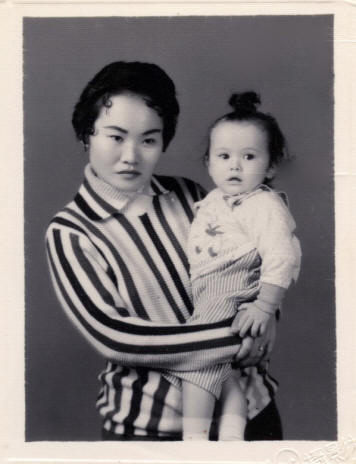
Pictured is columnist Dmae Roberts as a child (right) with her mother, Chu-Yin Lo Roberts.
It’s the 10-year anniversary of my mom’s death, and I still feel anger and pain. The five stages of grief have long left, but these two emotions keep coming back. Ten years ago, Chu-Yin Lo Roberts, my mom, passed away from a recurrence of breast cancer. Three years before that, her doctor left her in a hospital gown in a cold radiology room not knowing why she was there. She called me, crying, when I was two hours away by car and unable to help her. Six months before that, I took a weekend flight to Taipei, Taiwan to rescue her.
Time and distance. They say that it heals all wounds. Who are "they" — these mysterious people who offer sayings with vague meanings? Can a lifetime of wounds ever heal completely?
Time and distance separated my mom and me. We were of different races, generations, cultures, and languages. Time seemed long as a child. Slow and oppressive, speeding up until I moved away to create more distance from our arguments over my life, my work, and my problems — everything she needed to fight about. Behind it all, she knew I could never fill the black hole of her need for love and her feeling of being abused by life.
World War II and starvation in Taiwan left her wounds wide open, but what scarred her for life was the fact that her parents sold her into human bondage for 20 yen because they needed rice. How could anyone overcome being unwanted? Her lack of love was passed to my brother and me not because she was cruel, but because she needed more love than she could give. Yet she wanted me to love her as a filial Asian daughter should love a mother.
In 1989, I produced a radio documentary called Mei Mei, A Daughter’s Song, and travelled with my mother to Taiwan. We both hadn’t been back for 25 years, so I naïvely thought it would be a bonding experience for us. We mostly fought and by the time we returned, we quit talking to each other. I was later honored with a Peabody Award for the production, but she hated it. She said I told everyone she was a "dirty Taiwanese." Her words were intended to sting. They did.
Ma kept a temple to Kuan Yin, the Asian goddess of compassion and mercy, in her house. There is a transformational parable about her as a princess named Miaoshan. Though her father was cruel to her, she saved his life by cutting off her own arms and gouging out her eyes to make a healing potion. Miaoshan then attained enlightenment and became Kuan Yin. The Chinese term for this is Ko-Gu, a practice in which a daughter cuts a piece of her flesh to cook in a soup to heal a dying parent. In an effort to save my mom’s life, I performed a symbolic Ko-Gu and gave up a part of my life to try to save hers … if only for a little while.
During a time when we were on good terms, my mom travelled to Taiwan. One day I received an e-mail from a relative I did not know who said she was sick. He asked if I would come get her. I flew to Taiwan over a weekend to bring her back. When I got there, I knew something was wrong, and I flew her home to a hospital in Eugene. Ma had a severe infection. Later she was diagnosed with a recurrence of breast cancer that had metastasized in her lungs.
I took care of my mom for three years, commuting back and forth from Portland to Eugene. I did a maddening dance with cancer and caregiving. I found doctors who didn’t explain to my mom what was happening because they thought she couldn’t understand English. I danced between my mom’s stubbornness, anger, and depression. Ma was on her deathbed three times. The first two times she survived. In the end, she didn’t go easy and died struggling to breathe when her lungs collapsed.
I inherited my mother’s anger caused by war, starvation, and abandonment. I added my own resentment of being an early adult and servant and protector trying to help my Taiwanese mom survive.
Sometimes she’s in my dreams as a child, a beautiful young mom, or in her later years, but never as she was in her final days. We often laugh together. I awaken angry she died like she did, angry the world had disappointed her. Anger and pain have a purpose. As do time and distance. Maybe the concept of healing is fleeting. Maybe like perfection, it doesn’t exist. Maybe it’s a process called living.
I often think back to a fun time in Taiwan when we dealt with some noisy neighbors. I told them in broken Chinese that their son was stomping around above us. We both giggled about it. When we could laugh together, there was no greater feeling and no greater bond. This is how I ended the Mei Mei documentary and how I end this musing on time and distance, anger and pain.
|