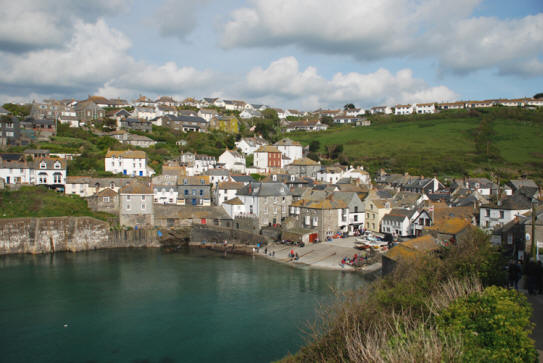
The village of Port Isaac, a picturesque fishing village surrounding a beautiful harbor, is located on the Atlantic Coast in England. (Photo/Richard Jensen)
This past spring I travelled to Cornwall near the village of Port Isaac. Ever since watching "Poldark," my first British Broadcasting Corporation (BBC) show during the 1970s, I’ve always wanted to visit this part of England. When the more recent quirky comedy "Doc Martin" set in Port Isaac started airing on the Public Broadcasting Service (PBS), I vowed to one day visit the area.
I discovered Masterpiece Theatre on PBS at age 11. I switched television channels after a "Star Trek" rerun and found "Poldark." The series followed the story of Ross Poldark in the 18th century. He owned tin mines, fought for the underclass, and married his servant, Demelza. It was a love story with corsets, big wigs, and pointy shoes — and it mesmerized me. I learned about class struggles and what life may have been like back then.
After watching the series, I devoured "Upstairs, Downstairs," a drama about an "upstairs" rich family and their "downstairs" servants. I became hooked on PBS. To this day, I’ll still watch any historical drama. The programs inspired me to read Shakespeare, Jane Austen, Charles Dickens, Thomas Hardy, and all the works by the Brontë sisters.
Travel has been my one luxury expense. I inherited my mom’s frugality and have saved money throughout my life. I started young, working summers in canneries and mills to put myself through college. After graduation, I saved as much as I could in order to backpack through Europe.
Throughout the years, I’ve used my savings to go to Asia and Europe. In Asia, travel served as a discovery of my mother’s cultural legacy, as well as my own. Whenever I’ve travelled to the British Isles, however, I feel as though I’ve entered a more exotic, déjà-vu world only found onscreen or in literature. I have visited film and television locations as well as literary settings in England — from Haworth, Yorkshire, where the Brontës lived, to Jane Austen’s house in Hampshire, to Arthur’s Avalon in Glastonbury.
My early experience with all things British included a fascination with manners, history, rules of behavior, and epic stories. Family lineages seemed a comfort amid the chaos of my own upbringing.
Though I credit "Star Trek" and the science fiction novels of Ursula K. Le Guin, Harlan Ellison, and Ray Bradbury for opening my mind to the future, exposure to Masterpiece Theatre and classic literature helped me imagine the past as lessons to help make sense of my life. It was a way to survive the tumult of a chaotic upbringing spent in cultural isolation with battling parents in rural Oregon. Science fiction, classic literature, and television all offered a window of hope.
With any kind of international travel, I gain independence while receiving a college semester’s worth of history, literary, and cultural lessons. Unfortunately, I travel less now. It had been nine years since my last trip to England, and I would never have made it this time were it not for an international radio documentary conference held at the BBC in London. I couldn’t pass up a chance to dip into my savings once again to take a side trip to Cornwall, a place I’ve wanted to visit since I was a youth.
What I found in Port Isaac was a picturesque fishing village surrounding a beautiful harbor. I met members of the Fisherman’s Friends, a group of 10 men who sing sea shanties in powerful harmonies. The area surrounding Port Isaac is unspoiled, green, and windswept. I marvelled at the many beautiful places in Cornwall, steeped in history that is noble, tragic, and inspiring. It’s not an easy life in the winter, however. Perhaps that saves the area of Cornwall from development.
After spending time in London at the conference, it was clear to me that England is battling American commercialism. But Cornwall and much of southern England are still winning the fight against the sprawl of strip malls and the addition of fast food chains.
I understand the reason that Poldark worked so hard to save his tin mine and bucolic village and why he stood on a cliff with the wind whipping about him as the sea roared on. The cliffs and the villages of Cornwall will continue to weather erosion and encroaching civilization long after I’ve gone. I find comfort in that.
|