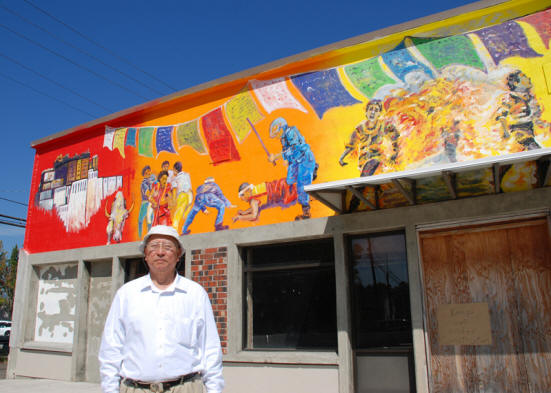
I recently travelled to Corvallis, Oregon, which is a bit farther from Portland than I remember. It’s usually a quiet college town, but this summer, it captured world attention for a large mural that Chinese officials found offensive.
The mural was commissioned by David Lin, a Taiwanese-American businessman. He is renovating the former Corvallis Microtechnology building to house what he hopes will be a restaurant next year. He says he doesn’t yet know what kind of food, but it will be "good and healthy."
On the side of the building is a 100-foot mural painted above the windows and doors. It depicts scenes of violence in Tibet and declarations of Taiwanese freedom. Lin says he was moved to have the mural painted when a friend showed him photos of monks in Tibet protesting against China.
One of the pictures is the police harassing a monk and the other picture is the Chinese police beating a monk, according to Lin. "It’s tremendous human suffering," Lin said. He felt he could not keep silent and had to speak out. He wanted to make an international statement for Tibet but also about his concerns for Taiwan, where he grew up.
As a fellow Taiwanese American, I could understand why Lin would want to bring attention to China’s dominance in regard to both countries. Ever since Chiang Kai-Shek fled China to Taiwan after the Nationalist Party lost in 1949, China has insisted that Taiwan is a territory. But as Lin says, China has never owned Taiwan. Other countries such as Portugal and Japan have occupied Taiwan, but never China. Lin wanted to bring attention to his homeland and the atrocities in Tibet.
To do this, Lin obtained all the required city permits for a mural. On a trip to Taiwan, he met Taiwanese artist Chao Tsung-song. Lin paid for the artist’s flight to the U.S. as well as his room and board while painting the mural this past summer. Almost immediately, the mural drew attention. On the right side are pastoral scenes of Taiwan; nearby, lanterns float to the sky with messages of independence written in Chinese. On the left side of the mural, there’s a graphic image of self-immolation by Tibetan monks.
"This is obviously the people who burn themselves, to give the strongest protests to the Chinese government," Lin said, "The next one is three Chinese police trying to harass a monk."
Corvallis City Hall is just a block from the mural. In early August, Corvallis mayor Julie Manning received a letter from the Chinese Consulate General in San Francisco. The letter said that the mural "caused strong resentment" from the local Chinese community and Chinese students studying in the U.S.
"There was an expression of concern for the mural and what was depicted there," said Manning. They thought the local government should take some sort action.
The desired action, according to the letter, was to urge the city to "stop the activities advocating ‘Tibet Independence’ and ‘Taiwan Independence’ in Corvallis." The letter also urged the mayor to "avoid our precious friendship from being tainted ..."
Mayor Manning traded e-mails with the Chinese consulate, which led to two consulate representatives flying to Corvallis from San Francisco for a meeting.
"We talked about the artistic expression and how that is an element of the First Amendment of the U.S. Constitution and how we really did not view there was a role for local government … because the property owner was not violating any laws," Manning said.
Oregon senator Ron Wyden and congressman Peter DeFazio have both publicly blasted the Chinese diplomats for their lack of familiarity with the U.S. Constitution.
Mayor Manning said members of the Chinese community in Corvallis have shown support for the city’s stance. She said she has also received positive e-mails from all over the world, many from people of Chinese descent.
In mid-September, members of the Northwest Tibetan Cultural Association held a ceremonial event at Lin’s mural in Corvallis. They placed traditional scarves at the site to show respect for the mural’s message. Lin said he’s proud his message of peace and independence has had such an effect.
To me, this is a statement not only of the power of art, but of the strength of one individual to make a difference.
|