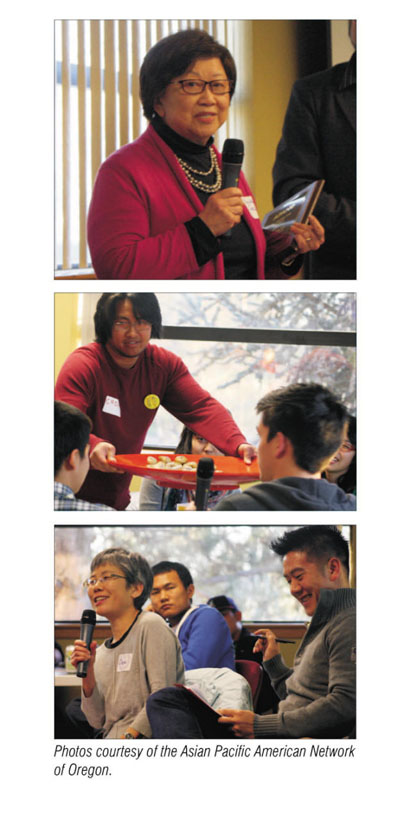
This year’s APANO (Asian Pacific American Network of Oregon) convention was many things. Many things to many people, and sure it should be. I mean, imagine if you can, asking all those nationalities and ethnicities west of Seaside into a generic room, streaming them through a narrow door someone else screwed a brassy little "Asian Pacific American" on. No one I know invented that enormous noun compound.
Imagine all our vigorous families: Thai, Taiwan, and Tongan; Khmer, Karen, and Korean; Hmong, Malaysian Chinese, and Marshall Islanders, all packed in there without proper regard for the complex intersections of our long histories; without proper shoulder pads, shin guards, or face shields.
Now imagine adding another 20 or so distinct ethno-cultural communities on top of those nine — picture them all showing up with four generations, from five of our wobbly world’s religious traditions, and in every love orientation under heaven. Some of us are foreign born, some are U.S. born. Finally, mix in the agitation and anxiety that American minority marginalization makes even of our most ambitious families.
And there you have it: APANO’s fourth Statewide Convention — API Communities in Action.
This year’s gathering began with advocacy training and visits to state reps and senators at the Oregon Legislative Assembly; an evening of speakers, music, traditional and contemporary cuisine at Salem’s downtown First Congregational United Church followed; Saturday was dawn to dusk workshops on the Winema campus of Chemeketa Community College.
Some major moments
All those differences in geography and demography aside, the convention was executed and ended with great civility. And extraordinary promise. As with past APANO statewide events, there’s really no adequate way of acknowledging those thousands of hours contributed by the nonprofit organization’s slim staff and huge crew of volunteer activists. Together they extracted a shared ethos from our many cultures, created an inclusive family over a weekend of hard-hard work, and created common cause for a year of Communities in Action. The heart of social justice, it seems, is peace at home.
Easier than all that engineering is summing it all up in, let’s say, three major moments out of a long and dense weekend of expert and inspiring speakers, educational presentations, energetic trainings and workshops.
So please know that the following sampling is not based on merit. They are three events I attended and can competently report on. Even though multi-tasking is now a basic survival skill, most of us are still limited to being at one place at a time.
Saturday morning, even earlier than Oregon songbirds, Portland State University assistant professor Ann Curry-Stevens and Lee Po Cha, co-chair of the Coalition of Communities of Color (CCC), founder and director of the Immigrant and Refugee Community Organization’s Asian Family Center, and an original APANO organizer, presented CCC’s sobering soon-to-be-released research on urban Multnomah County’s Asian and Pacific Islander communities.
Rather than deepening stereotypical ruts about Asian families as "model American minorities" — rather than supporting the wishful thinking some Oregon’s policy leaders invoke when unkindly comparing Asian integration to that of other ethnic minority communities — the data sets out in stark graphics the awful institutional barriers to actual academic, workplace, and economic success. Even when researchers factored for income levels or social class, being Asian is still a determinate for local success. Or failure.
Honoring Dr. Phyllis Lee
A second big moment at APANO’s convention, indeed a high watermark in Asian Oregon history, was the inaugural presentation of the Dr. Phyllis S. Lee Award for Outstanding Advocacy. First honors were of course conferred on our pioneering civil-rights activist, esteemed professor, and elder stateswoman, Dr. Phyllis S. Lee.
A complete inventory of all her awards would take several of this newspaper’s pages, so simpler might be saying that Dr. Lee grew up between the aisles of her parent’s Chinatown grocery store and taught elementary school before brawling for school desegregation in Oregon’s raucous 1960s. She played the part of big cannon during our 1980s state legislative struggles for Asian extended family integrity.
During the 1990s, through her work as director of Oregon State University’s President’s Office of Multicultural Affairs and as an elder auntie in Portland’s ethnic enclaves, Dr. Lee established Oregon State as what’s expected from local Asian and islander kids right after high school. For her commitment to the Rev. Dr. Martin Luther King, Jr.’s teachings, OSU created the annual Phyllis S. Lee Award for Social Justice.
Over the last decade, Dr. Lee framed and led APANO’s educational equity initiatives. That’s 50 years of teaching, explaining, and problem solving — but we’re not counting and the Honorable Phyllis Lee is not tiring.
Spiritual and communal longing
This essay’s final note on APANO’s annual convention may well be as surprising as it is reassuring. And on reflection, might be indicative of the organization moving in one more good direction.
Only a handful of participants had pre-registered for "Organizing in our Faith Communities," an afternoon workshop with lots of strong competition for the same Saturday time slot. As the session started, it seemed we’d have an intimate conversation among participants from our Christian, Muslim, Hindu, Newar and Theravada Buddha religious traditions plus perhaps a few existentially uncommitted. But by showtime, the room was packed and voices were raised to reach folks way in back.
Talking about faith is hard in America. Separation between church and state is firm in public school. Post-secondary liberal western education does not cultivate a vocabulary for bridging the divorce. Conversation on spiritual life is rare in public life, except during political campaigns, when it’s tense, intended to divide and elevate the faithful from the less so.
I don’t have the data handy but I’ll bet Oregon’s Asians and islanders represent the diversity of spiritual articulation and the big-hearted blending of all the religious traditions you’ll find west of Cannon Beach all the way over to, say, East End London. We’re that deep and that complex.
Likewise, you can be sure that our essentially human longing for communion with the great purpose and the grand mystery of our Creator, right alongside our longing for communion with one another in sacred places for these sacred moments, comes along with our families when we jumbo jet here. To America.
Again, I don’t own the three-ring research binder confirming this, but there’s plenty of evidence in both north and east Portland’s many-many evangelical churches, full of Asian, African, Latino, and Slavic families converting from traditional institutions to contemporary ones. The aesthetic of the welcoming house of worship may’ve shifted, but ethnic America’s longing for sacred communion remains a strong constant. Sure it is.
So, our Saturday afternoon session so unexpectedly packed was a lesson. A big one. Then came Lesson Two, one just as humbling and just as sudden in its reversal of what convention planners anticipated. "How can APANO assist our faith communities do their good work" — turned a quick 180 degrees into an examination of what our spiritually tough and tender Asians and islanders can do to make APANO more relevant. More inclusive. More communal.
As suggested about 1,000 words ago, APANO’s 2012 convention was many things. Many things to many people, and sure it had to be. We didn’t invent that enormous noun compound — Asian Pacific American — we just live it.
And we’re getting better and better at it, all the time. Mr. Lee Po Cha and professor Curry-Stevens are getting our arms around it. Quantifying and qualifying our sorrows and our joys. Methodically sorting out our aggregate parts. Khmer, Karen, and Korean are not the same kinds of communities.
Honoring Auntie Dr. Phyllis Lee, as common history and as today’s gold standard, is giving us focus. Acknowledging and consolidating the enormous spiritual capital banked in our Asian and islander families, and expressed in our faith communities, is making us bigger.
There you have it: A better and bigger Us.
* * *
Notas:
Grabbing and talking up only three of so many convention greats is not fair, and neither is the following list of community organizers and APANO staff. Better is simply saying that our dozens of committed civic activists made possible the work of those folks named below. You made them look good. Wa terima kasih banyak (and we offer you our love, in gratitude).
APANO 2012 Convention
Program committee co-chairs: Mdme. Pia De Leon and Rev. Joseph Santos-Lyons
Program committee: Ria Moli, Patricia Lim-Pardo, and Ketsamaly Sisoukpanthong
Convention associate: Ka Her
Co-moderators: Mdme. June Arima Schumann and Gauri Shanker Rajbaidya
Convention graphic designer: Phamala Luangphasy
APANO Legislative Day of Action
Lead civic activists: Jessica Chanay, Narayan Lamichhane, Jessica Lee, Alvin Ma, Chi Nguyen, Huy Ong, Gauri Rajbaidya, June Arima Schumann, Thida Win, Phillip Kennedy-Wong, and the Hon. King Zam
APANO Staff
John Joo, Colin Kiley, Anthony Kim, and Gennie Nguyen
Editor’s note: Polo is a founding member of APANO and a current board director.
|