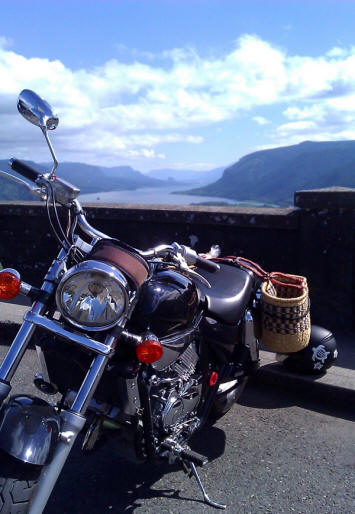
I am riding along broadshouldered River Columbia, eastbound on gusty North Marine Drive. I am cruising in the mid-50s — me in years, my motorbike in miles per hour.
And I am afraid. Maybe because I am old. Suddenly and irrevocably old. I fear losing my grip or running into an ugly rill in the asphalt. I fear drifting into memories of other places and other times, not noticing the big truck ahead, slowing down. I imagine slamming, face first, into his unforgiving backside.
I am suddenly afraid of a thousand possibilities. All bad. Probably because of my years. Young guys don’t think these things. Deadly things. Maybe motorcycles are for younger men.
Our pop bought me my first motorbike. A red Honda 100. Model SL: Snappy kickstarter, single piston, plenty of torque. Secondhand from the father-in-law of a guy at work, at the JC Penney loading dock.
The old tio told us he’d strapped that bike onto his RV’s rear bumper. "For campin’ trips."
"I jus’ don’ ride anymore," he said after some silence, as he and Pop and me stood, hands deep inside pants pockets, American-style, in his tidy suburban Salem driveway. His wife was inside, at her kitchen window. He said those things, looking longingly at her — I mean at his Honda 100. Pop and me gazed at her too — no seat tears, no tank dents, her aluminum brushed, her chrome polished. Perfecto. Tentu.
Americans can talk like that. Like that resigned old motorcycle man did. Dropping Gs. Contracting words. Abbreviating human experience. Not us. Tidak. Not in our momma’s house, and consequently never outside it. No lazy bones, no shortcuts, allowed.
Loving our things
And Americans can love things. Things like motorbikes. And you know, we do too.
"Care for her," our pop said about his sturdy olive Dodge pickup in Ambon. "Wa tentu, she’ll care for you." Big Uncle Harry said the same about his beige VW after we fled to Den Haag; Momma said it about her Singer sewing machine after we migrated to Salem.
We love our stuff, a lot. Sure we do. Islanders are like that. Maybe because what island families have, is all we have. Punto. There is no more, to have. And maybe that’s different from how it is in America. Here we have Costco-size shopping carts and Randall’s Chuck Wagon, All You Can Eat.
So when our pop, exhausted but never defeated after another humiliating American workweek in that department store stockroom, bought his second boy — his first college kid, the first in our ancestors’ long-long memory — that apple-red Honda 100: It was love at first sight. I loved those raked handlebars, those elegantly curved exhaust and tail pipes. Love of the machine.
Love of the machine is a feeling some have. Some not. More men than women, it seems to me. It’s about the steady synchronicity of several elements not naturally bolted together, working well together. Stubborn iron and viscous oil, vaporized gasoline and a microsecond of blue lightning. It’s about the well-tuned machine combusting and containing the compressed terror of those unlikely roommates over and over and over again. 1,200 times per minute when my baby idles. 3,000 times per minute when she’s cruising historic Oregon Highway 30. Through Columbia’s River’s sacred gorge.
Motorbiking as meditation
I got my first Oregon motorcycle endorsement in 1972. I was headed for Duck U on an athletic scholarship, on my snappy Honda 100. President Nixon was in the White House. America was warring in Viet Nam, in neighboring Cambodia, and in the same adolescent error, secretly bombing another neighboring nation, the Kingdom of Laos. Not unlike today’s mistakes in Iraq, Afghanistan, and Pakistan.
Forty years have flown by since my first motorbike and America’s 37th president. Not long. Since then, our new country has warred 14 times. Of course, on bad leaders and good soldiers in their nice offices and packed barracks; but mostly on anxious wives and dreamy grandpas and earnest school kids, on their way to work, to coffee shops, to classrooms. Certainly, that’s the awful arithmetic of it all — our family’s done the actual accounting. We have lived where governments war.
And although none of that madness is actually going on here and now — not on this asphalt ribbon between Columbia’s basalt massif, not on this fragrant Sunday morning — these are the places, these are the times, going on and on just behind my eyeballs as I’m barrelling, clutch-braking, hip-shifting, into Crown Point’s deeply shadowed leeward curves. I blink them all away, all those distractions. I’ve got to get local. Get current. Quick.
Because, while past places fill our porous bones, while past times fill our heart’s chambers before pulsing out and all over the rest of us — only the present, only this present, secures my next moment’s success, even my survival. Focus is everything. Ask a cop or a firefighter or a soldier. People deliberately putting themselves in dangerous places and times must have mind and musculature firmly fixed in the present. Every next moment matters.
I need to be now. I bite my bottom lip. Blind curves are rushing at me. Whispering fir and ancient maple are casting complex shadows. Falling water and cascading streams, madly ionized hydrogen atoms, as intoxicating as red wine, are making every living thing high.
I need to be committed to this moment; to cam- and drive-chain tension; to front- and rear-tire whine. To me and machine in motion, inside our shared instant.
What’s more: since the practical and the spiritual are separated by only a slow breath or two — the present, only the present is where and when joy lives. The delight of complete presence in each moment. Joy, like our granddaughter feels when I carry her inside a cardboard box. The joy I am when her fat cheeks rise to eclipse her happy eyes. When she jumps to her feet, chubby arms wide. Kids love boxes. She is completely present, where and when this love is.
So, this is where I make a small promise to stay. A little oath to me and my motorbike.
I inhale the dank shadows of this place, the electric scent of this time, the sound of compression-braking into the curve under and ahead of us. She and me in this same moment.
Presence with the mechanical, presence for the sublime.
I’ll roll like that into work tomorrow. Transcendentally speaking, I mean. My baby I’ll park curbside.
* * *
The Asian Reporter’s Expanding American Lexicon
Ambon: an island and a folk of the 3,000-mile Indonesian archipelago. Where our family last lived.
Another humiliating American workweek: It is impossible to overstate the respect immigrant kids have for our fathers’ hard-hard work in unkind times and places.
Contracting words. Abbreviating human experience: Many Old Worlders interpret the speed and shallowness of American interaction as disrespectful. Many Old World younger generations envy and adopt this American style.
Den Haag: Capital of the Netherlands. Where our family lived after expulsion from Indonesia.
Hands deep inside pants pockets: Many Old World cultures interpret American casualness as disrespect. We are expected to stand attentively. Many Old Worlders, especially younger ones, envy and adopt this American casual attitude.
Living where governments war: It may be hard for urban Americans to appreciate what angry armies warring in your neighborhood does to families, to cities, to histories. It’s New Americans’ responsibility to tell it. To stop it.
Perfecto (Spanish, Tagalog, Indo patois): Perfect.
Punto (Spanish, Tagalog, Indo patois): Period.
Salem: Capital of Oregon. Where our family lived after emigrating from Holland.
Tentu (Bahasa Indonesia): Certainly. Of course. Obviously.
Tio (Spanish, Tagalog, Indo patois): Uncle. Address for a man your father’s age, signalling respect and affection.
Wa tentu (Bahasa Indonesia): And certainly. |