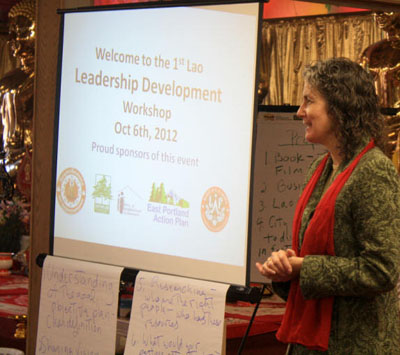
Lao-American community leaders who have long modelled county, state, even international leadership advocating for their families are now taking a big step into local governance. It’s an important new focus for an energetic ethnic enclave, a focus on integrating into Portland’s mainstream systems of municipal governance.
"Because of our city’s and our county’s commission form of government, what we really care about, our elected commissioners have to care about too," said Lao-Hmong-American civic activist Lee Po Cha before the final session of the five-Saturday seminar series "Community Connection, Civic Engagement & Lao Cultural Enhancement Workshops."
Participating in the last workshop held at northeast Portland’s venerable Buddhathammaram Temple were Arlene Kimura and Tom Lewis, presidents respectively of the very active Hazelwood and Centennial Neighborhood Associations; Lore Wintergreen, East Portland Action Plan advocate; and Eliza Lindsay, East Portland Neighborhood Office staff. Providing her own story as a kind of community compass, was city commissioner Amanda Fritz, also an immigrant who worked her way up Portland’s neighborhood associations to the top of elected leadership at City Hall.
Plugging into Portland’s neighborhood system
Since her tenure in public office, in response to ethnic minority and immigrant community engagement initiated by former mayor Tom Potter, commissioner Fritz’s Office of Neighborhood Involvement has provided newcomer communities ongoing participatory access to city governance through its Diversity and Civic Leadership academies. Her Office of Equity and Human Rights facilitates improving city services to refugee and immigrant families, as well as increasing access to municipal employment and contracting opportunities.
The Lao-American civic education series, like earlier immigrant integration workshops for Portland’s Iraqi-, Bhutanese-, Nepali-, and Russian-speaking communities, is funded by small grants from the East Portland Action Plan’s Civic Engagement Subcommittee. The seminars ending this month were further supported in kind and care by the Lao Senior Association, Hmong American Unity of Oregon, Lao Women Association, Iu Mien America, Lao United Association of Oregon, and a number of city bureaus trying to reach deeper into underserved far-east Portland neighborhoods.
According to Hongsa Chanthavong, president of the Lao American Foundation, as well as board member of the temple and community center hosting the seminar series, an average of 31 Lao, Lao Hmong, and Lao Iu Mien Portlanders of three generations and both genders participated over the summer into the fall. "Ten of those community advocates," he noted, nodding toward commissioner Fritz, "were graduates of the city’s Office of Neighborhood Involvement’s Diversity and Civic Leadership academies" — evidently taking their City Hall civics lessons back to their eastside neighborhoods.
"Refugee integration workshops like these," observed veteran activist and Community Connection program coordinator Vanhlang Khamsouk, "are our pipeline to local leadership" — aiming his remarks about next-generation responsibility across the room at younger Portland leaders like Lao Cultural Enhancement coordinator Lou Sundara.
A full circle of leadership
The necessity of youth empowerment for community development has not been lost to civic engagement workshop coordinator Phanida S. Sengsirivanh, a registered nurse and determined mother like commissioner Fritz. Ms. Sengsirivanh and the Lao Women Association have always made sure their kids are actively involved alongside adults in community events.
The final session of the 2012 "Community Connection, Civic Engagement & Lao Cultural Enhancement Workshop" in many ways brought full circle this particular local community’s journey from troubled Southeast Asia to vigorous far-east Portland.
Among activists gathered in Buddhathammaram Temple’s community space were Dr. Bolivong Tanovan, whose Columbia River watershed management skills he brought back across the Pacific to better steward the complex Mekong River system, and also the Hon. William Chu Blong Cha, subject of a 1997 PBS/WNET New York segment of "Imaging America," for his service to the United States as a Hmong SGU (Special Guerrilla Unit) fighter in highland Laos as well as a neighborhood peacemaker in marginalized Portland.
Said commissioner Fritz in her closing congratulations: "I didn’t understand the energy and the organization of east Portland’s immigrant communities until our work in the Office of Human Relations brought me out here just a few years ago." Today, Lao Americans are adding to that energy and organization, the essential ingredient elder civic activist Mr. Chanthavong calls "connection." Teamwork connecting across ethnic stream and mainstream communities.
For Portland’s Lao community it’s been a natural development — though it may be mistaken for evolution in reverse — a community moving from international to state to local leadership. Making "what we really care about" matter just as much to Portland’s elected officials. |