After a 22-year dry spell, Japan returned to the Little League World Series finals in 1998, and Japanese teams have appeared in eight more finals since then, winning four. No other country or U.S. state has been so successful in that span, although the west region of the U.S. has come close, especially lately. The Little League final has featured a team from Japan or the west region every year between 2001 and 2010, and each has appeared five times and won three times.
It was only fitting, then, that this year’s finals pitted Huntington Beach, California, a team from the west region, against Hamamatsu City, a Japanese team trying to be the first back-to-back Japanese winners since 1967-1968. The game would be the tightest matchup since 2007, when Georgia took eight innings to defeat Tokyo 3-2. In the end, Japan failed to repeat as Little League champions, but the Hamamatsu City team carried on even more important traditions instead.
Both teams dominated the qualifying regional tournaments leading up to the final. Huntington Beach won its first five games in the U.S. west region tournament by a combined 39-5 score, including three shutouts, before squeaking out a final 2-1 victory over Northern California. In the Japanese regional tournament, Hamamatsu City won its first three games by a cumulative 27-3 score and then defeated Yokohama City 14-3.
In the Little League championship tournament, both teams also shone, although Japan had the harder route. After wiping out the Caribbean team in their first game with a 12-1 score, Japan lost to Mexico, 3-2. This dropped Hamamatsu City to the losers’ bracket, where they shellacked Saudi Arabia 13-4 and blanked Canada 4-0 to reach the consolation final against Venezuela.
Though Venezuela was considered the offensive powerhouse, Japan hit three home runs, including two by first baseman Yoshiki Suzuki, to build an early 8-0 lead. Venezuela mounted a comeback with a five-run fifth inning, but Hamamatsu City held on to win, 9-6, advancing to a rematch against Mexico. Suzuki was the hero again, this time on the mound, striking out seven and stranding seven runners to help Japan defeat Mexico with a 5-2 score.
Huntington Beach, California had to rise through the consolation bracket, too, also ending in a rematch. After winning the first two games by a total 21-0 score, they got a taste of their own medicine when the Montana team representing the Northwest shut them out 1-0. California rebounded to defeat the local team from Clinton County, Pennsylvania, 2-0, before avenging its blanking by the Northwest with an 11-2 win.
Both teams also had players on the tournament leaderboard heading into the final game. Hamamatsu’s Suzuki led all hitters with 11 RBI and shared the lead for home runs with three while collecting two wins on the mound. Hagen Danner from Huntington Beach also won twice, and teammate Nick Pratto led all pitchers with 21 strikeouts; neither had allowed an earned run.
None of these players took the mound for the championship game, but the excellent pitching continued. Neither side gave up a hit through the first two innings before Japan struck in the third inning. Third baseman Seiya Fujita led off by poking an 0-2 pitch into right field, and Kaito Suzuki entered as special pinch runner for him. The next hitter, Shoto Totsuka, dropped down a beautiful bunt, forcing the American third baseman to field the ball and leave third base open. Suzuki took advantage, speeding around second, and first baseman Nick Pratto threw wide of third, allowing Suzuki to score.
The team from California struck back in the bottom of the frame, when Danner knotted the score with a solo homer. The game stayed tied until the sixth, an inning that proved decisive. Japan twice tried to bunt runners over, but excellent fielding by California’s pitcher Braydon Salzman thwarted both attempts, once nailing the potential go-ahead run at third base.
Japan’s defense, stellar throughout the tournament, failed the team in the bottom of the sixth, perhaps sparked by a pitching change. Kazuto Takakura moved from right field to the mound because Totsuka’s early walk problems pushed his pitch count too high. Takakura, rusty or nervous, issued a leadoff walk to Salzman and surrendered a single to the next batter, Dylan Palmer. Takakura fanned the next hitter for the first out, then induced a tailor-made double play to shortstop Gaishi Iguchi. But Iguchi bobbled the ball to load the bases, and the game-winning run stood just 60 feet from victory for the U.S. team.
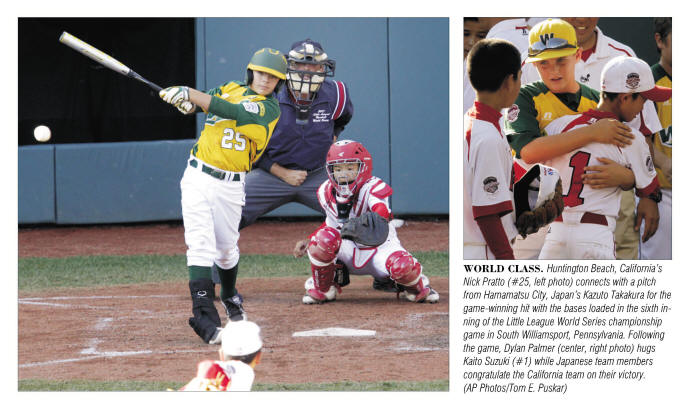
Suzuki fielded a grounder and forced the runner at home for the second out, and it looked like Takakura would escape. California third baseman Pratto had other ideas, though, ripping a line drive single into right center to bring home the winning run, scored by pinch runner Eric Anderson. Japan had played its heart out, but the west team’s heart proved to be a little bit larger, and the U.S. won the championship for the second time in three years.
Along with their Japan-west coast rivalry and excellent baseball skills, Japan carried on other Little League traditions, particularly good sportsmanship. Hamamatsu City waited until Huntington Beach had taken its victory lap, and then the team lined up to trade high-fives with its victorious opponents. In a sports world often lacking such gestures, Japan’s grace in defeat is an even more important tradition than victory.
|