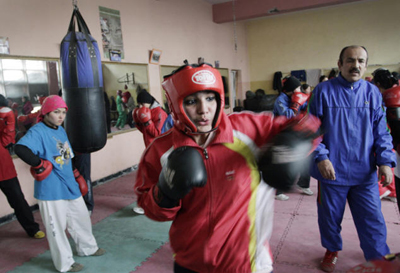
KABUL, Afghanistan — Besides going after a medal in the boxing ring at the London Olympics, Sadaf Rahimi will be taking a few punches in the fight for equal rights for Afghan women.
There are female Afghan success stories, yet most women in Afghanistan remain second-class citizens, many cloaked from head-to-toe in blue burqas, some abused or hidden in their homes.
Rahimi, a determined 17-year-old student, wants to become the new face of Afghan women, gaining honor and dignity for herself and other women in her war-torn country and improving their image worldwide.
She will get her chance this summer in London, where women’s boxing makes its Olympic debut.
"When we participate in the outside competitions, there is pressure on us," Rahimi said while training in a makeshift gym in the Afghan capital. "But I will try to show that an Afghan girl can enter the ring and achieve a position for Afghanistan."
In line with conservative norms for women in Afghanistan, Rahimi is expecting to wear black tights under her boxing gear at the Olympics to cover her knees. She trains for hours three days a week, punching heavy bags and sparring with her teammates and trainers.
They throw punches on faded pink and green mats covering the concrete floor of a room in an Afghan sports stadium where the hardline Taliban regime used to stage public executions. The female boxers still don’t have a real boxing ring to hone their skills.
After the Taliban banned women from participating in sporting events, the International Olympic Committee suspended Afghanistan from the games. Afghanistan missed the 2000 Olympics in Sydney as a result. The Taliban were toppled in 2001 and the suspension was lifted the following year. Afghanistan sent female athletes — for the first time in its history — to the 2004 Olympics in Athens.
Rahimi, who has the support of her family in Kabul, is following in the footsteps of Robina Muqimyar, the female Afghan runner who competed in Athens. Another woman, Mehboda Ahdyar, was scheduled to go to the 2008 Beijing Games but couldn’t compete because of injuries.
"I am well aware that my opponents in the London 2012 Olympics are more powerful and even twice as good as me, but I have prepared myself to participate and win a medal," said Rahimi, who started boxing four years ago and won a silver medal during a boxing competition in Tajikistan.
Female boxing is an unusual sport in a country like Afghanistan, where most of the women are still struggling for their rights and get little respect in the male-dominated society.
Recently in Baghlan province in the north, 15-year-old Sahar Gul was locked up, beaten with cables, and tortured by her husband and in-laws after she refused to work as a prostitute. They deny any wrongdoing. She became the bruised and bloodied face of women’s rights in Afghanistan after being rescued in late December when an uncle called police.
Her story shocked Afghanistan and prompted calls to end underage marriage. The legal marriage age in Afghanistan is 16, but the United Nations estimates that half of all girls are forced to marry before their 16th birthday.
In Kunduz province, also in the north, a 30-year-old woman named Storay was killed last month because she gave birth to a third baby girl instead of a boy. Storay, who used only one name, was slain, allegedly by her husband, when her third child was three months old. Her husband has left the family.
Despite such atrocities, there are increasing opportunities for Afghan women who want to participate in sports, said Mohammad Saber Sharifi, the coach of the Afghan female boxing team.
The team was established by the Afghan Olympic Committee in 2007 and so far has registered more than two dozen female boxers.
Rahimi, who fights in the 54-kilogram (118.8 pounds) weight class, will get into the Olympics through a wild card berth. She was scheduled to travel to London over the weekend to train for several weeks. In May she will fight in a competition in China, but win or lose there, she will be at the Olympics in London.
"Sadaf Rahimi is the only girl who will participate in these games," Sharifi said. "She will represent all Afghan women, which makes her the biggest female personality in Afghanistan."
Things have been much easier for male athletes in Afghanistan.
Afghanistan’s first Olympic medal winner was Rohullah Nikpai, who won a bronze medal in men’s taekwondo in 2008, defeating rivals from Germany and England as well as Spanish world champion Juan Antonio Ramos at the Beijing Games.
Because of insecurity in Afghanistan, his family fled to Iran where he grew up. He returned to Afghanistan in 2004 — three years after the Taliban government collapsed. After participating in Beijing, he became a symbol of national pride.
"In the 2008 Olympics, I won a bronze medal and I am hopeful to win a gold medal in the Olympic 2012 in London," Nikpai said.
Two other male athletes will round out the foursome who will represent Afghanistan in this year’s games. Massoud Azizi, a 25-year-old, 100-meter sprinter who competed in 2008 in Beijing, and Nasar Ahmad Bahawi, another taekwondo fighter.
"The people are expecting a lot from us. We know we will face the hardest opponents," said Bahawi, who practices inside a newly built gym at the sports stadium under the supervision of a foreign coach and Afghan trainer. "We have the prayers of our people, and god willing, we will do well."
|