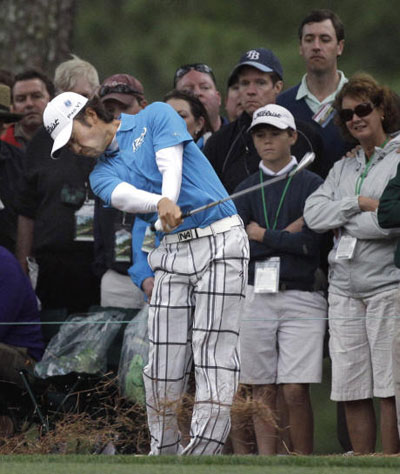
Since Vijay Singh of Fiji became the first Asian golfer to win the Masters in 2000, more Asian golfers than ever have entered the tournament, thanks to an eastern surge in golf talent. But in that time, only four other Asians and one Asian American have even reached the tournament’s top ten. This year, eight Asian or Asian-American golfers entered the Masters, but only one came close to cracking the hallowed tournament’s top ten.
South Koreans dominated this year’s Asian entrants, including faces both familiar and new. The well-known K.J. Choi and Yong-eun Yang qualified on the basis of past championships and current PGA play, while Kyung-tae Kim and Sang-moon Bae received invitations based on their World Golf Rankings.
Kim, the Japan Tour money winner for the past two years, finished 44th in his 2011 Masters debut.
Another standout on the Japan Tour, Bae qualified for the PGA Tour last December, and in his nine tour events before the Masters, Bae tied for second in the Transitions Championship and tied for fifth in the Accenture Match Play Championship.
Two excellent young golfers, one very familiar, one less so, represented Japan in the 2012 Masters. Hideki Matsuyama’s second straight Asian Amateur Championship again earned him a Masters invitation. In the 2011 Masters, Matsuyama became the first Asian golfer to win the Silver Cup as the amateur with the lowest round. He ended the 2011 tournament tied for 27th, but he didn’t shoot nearly as well this year, eventually tying for 54th. His even-par Saturday and one-under first-round were wiped out by a 74 on Friday and an 80 on Sunday when he shot four bogeys and a double-bogey before the clubhouse turn.
Matsuyama’s finish was much better than his more famous countryman, Ryo Ishikawa, who received his third straight special Masters invitation due to his excellent young career. The 21-year-old Ishikawa became the youngest-ever winner on the Japan Tour at age 15, went on to become the only teenager to win the Japan Tour, and has won eight more worldwide tournaments since.
Last season, Ishikawa donated all of his PGA earnings, plus a bonus for every birdie, to Japan’s earthquake and tsunami survivors, a donation that added up to almost $250,000.
This year, Ishikawa has already earned more than twice that amount, but he stumbled at Augusta, particularly on the first, ninth, 12th, and 18th holes. He collected six bogies and two double-bogies on those four holes in the first two rounds, missing the cut by four strokes.
Also failing to make the cut were K.J. Choi and Kyung-Tae Kim. Kim shot well on the first day, offsetting five bogeys with three birdies, but the wheels fell off the cart on Friday. He shot over par on five of the final 10 holes, including a disastrous double-bogey on 15. Choi also faded late, shooting over par on six of the final 10 holes in the first round to break a streak of nine straight rounds under par at Augusta. On Friday, a different stretch of holes, seven through nine, added four shots to Choi’s score, and he sank below the cut line.
Choi’s other South Korean countrymen did much better, however. Yong-eun Yang shot one-over in the first round, then picked up two strokes on Friday to get him well under the cut line. Then Yang fell apart on the weekend, shooting three over par on Saturday and collapsing with six bogies and two double-bogies on Sunday to finish tied for 57th place.
Sang-moon Bae also recovered from a slow start, but in much more dramatic fashion than Yang and finished 20 spots higher. After a weak Thursday, Bae followed bogies with birdies and eagles on Friday to make the cut. A Saturday eagle on two helped vault him all the way to 19th place, but Sunday proved unlucky, as he double-bogeyed the first and 13th holes and closed out his round with two straight bogeys.
Finishing 10 spots higher than Bae, Vijay Singh leveraged his excellent short game to strong scores on three of the tournament’s four days. He birdied six of the last 11 holes on Thursday, chipped in for eagle on Friday to help erase three bogies, and birdied four of the first 10 holes on Sunday. But on Saturday, he carded four bogeys over those same 10 holes and two more after the turn, for a 76 that put him in a tie for 27th overall.
The best eastern finish came from Korean-American golfer Kevin Na, who has played on the PGA Tour since 2001, but has emerged only recently. He picked up his first victory last season, setting a course record, and carded four top-10 finishes this season before the Masters, his third appearance.
He failed to make the cut in his two prior Masters, but this year, Na dominated the 13th hole, birdieing it Thursday and then eagling it Friday to help him overcome a six-bogey day. Saturday’s 72 saw him birdie 13 again to put him in a tie for 32nd place, five strokes away from the top 10. Na lost one of those strokes in the first hole on Sunday, but he went on to shoot five birdies — including another on 13 — to finish with a 68, his best Masters round ever.
Despite such an impressive final day, Na only finished 12th place overall, just two strokes away from cracking the top 10. But his payday of more than $156,000 almost equalled the Masters winnings of all the other Asian golfers combined. With so many strong finishes from this young eastern contingent, we’re sure to see more top-10 finishes — and hopefully another victory — at the Masters tournament soon.
|