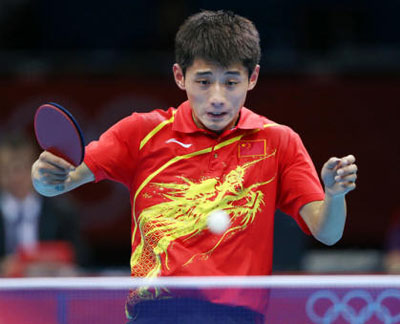
LONDON — China again swept all four Olympic gold medals in table tennis, just like it did four years ago at home in Beijing.
In fact, men’s coach Liu Guoliang said China has the "homecourt advantage" no matter where it plays.
"In table tennis, wherever it is, we are the hosts," said Liu after China delivered one of its most pressure-packed gold medals of the London Olympics, completing the sweep with a 3-0 victory over South Korea in the men’s team final.
"Being the hosts in Beijing four years ago, we had some advantages, the good atmosphere," he added. "You walked into the arena and all the Chinese were supporting us."
It was that way in the British capital throughout the 12-day table tennis tournament, and particularly August 8. The 6,000-seat area quilted with hundreds of red and yellow Chinese flags, and thundering chants of "Jai Yo, Jai Yo" (Let’s Go) drummed out the ping, pong, ping, pong.
The sweep was expected, and anything less could have prompted shakeups in the government bureaucracy that oversees the sport. Table tennis is the national pastime and source of patriotic pride.
China has won 24 of 28 gold medals since the sport entered the Olympics in 1988. They won two gold and two silvers in singles at the London Games. They could have won more, but nations this time were limited to two singles players instead of three.
China also took the women’s team gold.
China is too good, backed by a state-run sports system that keeps cranking out the world’s best players.
South Korean coach Yoo Nam-kyu, a singles gold medalist in 1988, suggested some players are beaten just knowing the opponent is Chinese.
"Players might be confident the first time they play China, but when they lose once, twice, or 10 times, it’s only natural they are already beaten," he said. "Even if they are not psychologically vulnerable, they are always questioning if they have the same amount of training to complete with their Chinese counterparts."
China’s Ma Long defeated Ryu Seung-min, the 2004 Olympic singles champion, in the first set of the best-of-five series, which combines singles and doubles. That set the stage for China’s sweep with gold medalist Zhang Jike beating Joo Sae-hyuk, followed by the doubles victory to make it 3-0.
Zhang, who struggled to beat Joo, stood in front of the umpire after the match and raised his right fist, a gesture the umpire makes awarding points.
"Because I won that last point, I just wanted to play the role of the umpire to give myself a point," said Zhang, who said from the start he was confident of winning both golds.
Many believe the "real" men’s final came in the semifinals when China defeated a stubborn Germany led by Timo Boll, the top-ranked non-China player in the game.
Germany defeated Hong Kong — a team composed of three players born in mainland China — 3-1 to take bronze.
The gold medal match prompted traffic on Sina Weibo, China’s version of Twitter. Predictably, there was overwhelming support for China’s team, but also comments questioning the cost of winning gold in so many sports. Some called it an "obsession."
Adham Sharara, the president of the International Table Tennis Federation, has encouraged China to share its expertise, afraid the world will grow bored of dominance by one country. He said they have been cooperating.
"It will change in the next four or five years," Sharara said in an interview with The Associated Press. "You will see other teams will win. Otherwise, of course, it’s very disturbing to have the same — whether it’s China or the U.S. — winning for too long."
|