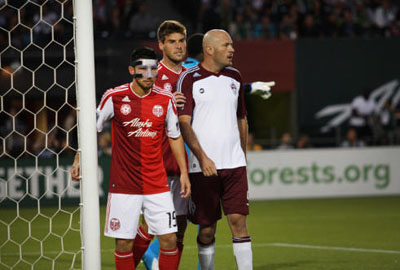
In July, the Portland Timbers traded for Colorado Rapids defender Kosuke Kimura, a player instrumental in the Rapids’ 2010 Major League Soccer (MLS) championship and their return to the playoffs in 2011. Timbers fans applauded the club’s acquisition of the six-year veteran, who is also the league’s first Japan-born MLS player. I interviewed Kimura recently, and he talked about his decision to come to the United States and his tough, intelligent, winning approach to soccer.
When he was 15 years old and playing for the reserve squad of the Japan Professional Football League’s first-division Kawasaki Frontale, Kimura’s pro career seemed secure. "They loved me there because I was quick," he said. "But almost three years later, I got a bad stress fracture [in my foot], and I didn’t play for almost nine months." All that down time dulled his skills, and Frontale released him, forcing Kimura to make a life-changing decision.
Kimura felt his skills were too rusty to try out for other J.League teams, so he considered going to college. But Japanese pro teams don’t recruit college graduates; they prefer younger high-school players. Giving up his dream of playing pro wasn’t an option, not after he’d dedicated his life to the game, but that dream seemed impossible — until his best friend told him about the pro system in the U.S., which recruits college players, not high schoolers. In America, Kimura could develop his skills and obtain an education while still working toward his dream.
So Kimura enrolled at Western Illinois, where he not only regained his soccer skills, but also matured and developed a strong work ethic.
"In the college system, you have to work hard," he explained. "You have school, and at the same time you have to play. You have to dedicate your heart. You have to have that work ethic, or you won’t make it."
Hard work and maturity have, in turn, been vital to his on-field success. "If you join a pro team [straight out of high school], there are guys who have been playing for 15, 16 years. If you try to compete with those guys just on talent, there’s no chance. You have to think, to dedicate everything you have to soccer, to work hard."
His toughness and dedication caught the eye of the Rapids, who drafted Kimura in 2007, making him the first Japan-born player in MLS history.
"I didn’t know until they told me," he said of the distinction. "It didn’t occur to me right away, but I knew I should be a good example for the Japanese people who come through later on. It gives me a little more juice to play, more energy, because I have to be a good example for them and hope to bring more players here."
Since Kimura’s MLS debut, other Japanese players have been signed, but few have adjusted to American soccer, which is played more physically than in Japan.
"Lots of Japanese guys come here, and they’re skillful, but that’s about it," he said. "Skill can only take you so far. If you’re not strong enough, [American players are] just gonna go through you."
Kimura is smaller than many of his opponents, adding an extra wrinkle to the physical challenge. "I’m way lighter than anyone else on the team, but it doesn’t matter because I’m as mentally strong as anybody else. I make sure I get to the ball faster than anyone else, but before that, I think about the position. I put myself in a good position so I don’t have to sprint faster."
Sometimes, this approach tests his toughness to the limit. In a recent match against the New York Red Bulls, Kimura tried to stay between Red Bulls midfielder Tim Cahill and the Timbers’ goal. Cahill elbowed Kimura in the face, giving him a concussion and breaking his nose so badly that he will need offseason surgery to repair the damage.
Kimura didn’t let that injury keep him from the team’s next game against the Vancouver Whitecaps on Saturday, August 25. He wore a clear mask to protect his nose and played as aggressively as ever, typical for a player used to doing things the hard way.
"Somewhere in myself, I think I know that I cannot take the easy way out," Kimura said. "It’s in me, I’ve been doing it this way for a long time. Take the harder way, take a different path than what most people do, and I’ve been successful."
This attitude fits exactly with Kimura’s perspective on achieving his dreams. "Everybody says you should chase your dream — I hate that word ‘chasing.’ It’s not chasing. By working hard every day, by thinking about it every day, truly from the bottom of your heart, you actually pull that towards you. So actually the dream is chasing you — you’re not chasing the dream."
Kimura shares this approach with others, from teammates to fans. He earned the Rapids’ 2010 Humanitarian of the Year award for his charity work, work he intends to continue in Portland.
"We have to give back to the community for what they give us … I’m in the right position to do that, and I’m more than happy to help people, especially kids. I’m looking forward to staying with the team for much longer and building a good relationship with the fans with more community service."
He also helps his fellow Timbers with his toughness and championship experience. "I bring a work ethic and the determination you have to have to be a champion, to be a winner. It’s a habit, and you have to want it to get better, every day. It’s tough because we’ve been losing games, and that’s become a little habit. We haven’t been playing well, and some people might give up, but I never give up — I can’t give up. That’s the mentality I have to have, to spread that like an infection. You can really infect somebody, and that guy can infect somebody else."
Kimura’s love for soccer and his tough, smart approach to the game will no doubt infect Asian-American sports fans, too, giving us all another reason to root for the Portland Timbers.
|